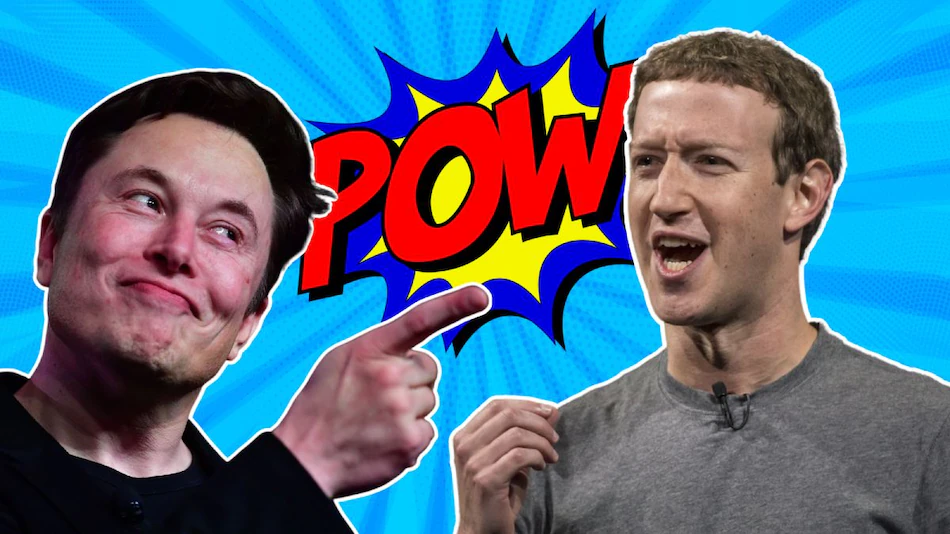
The rumored cage match between Mark Zuckerberg and Elon Musk has remained in the “will it or won’t it happen” phase, leaving millions both amused and fascinated. Musk previously stated that the bout would be livestreamed on his social media platform, X (formerly Twitter), but later announced that he would first need an MRI to determine whether the titanium plate in his neck—a remnant from a sumo wrestling match about nine years ago—requires surgical “reinforcement.” The Tesla “Technoking and CEO” noted on X that a “specific date” for the mixed martial arts (MMA) contest has yet to be set. Zuckerberg, meanwhile, responded on his own platform, Threads, saying, “I’m ready today,” though he added that he isn’t “holding his breath.”
Given the current physical condition of the Facebook founder, a delay might be a sensible move. Yet, it only serves to heighten the anticipation for those eager to witness a showdown between these two billionaires. Typically, such rivalries play out through the fluctuating stock values of their respective companies—a arena in which Musk is currently the most prominent figure. As my colleague Adrian Wooldridge recently observed, a head-to-head clash between these tech titans might finally settle the question of who reigns supreme among the “alpha males” of Silicon Valley.
I get the thrill of a one-on-one showdown. Monster versus monster? Count me in! (I got up bright and early to catch the global premiere of Godzilla vs. Kong.) Novak Djokovic facing off against any of the world’s top five men’s singles tennis players? I’m all for it. Alexis versus Krystle in the TV series Dynasty? Okay, I guess that just gave away my age.
Not long ago—in 2005, to be precise—I found myself drawn to the resurgence of MMA. This revival was sparked by a reality television show that culminated in a heart-pounding cage fight—an event I covered for Time magazine. Here is how I described the resurgence—a match that breathed new life into a sport once on the brink of extinction, and which today has even captured the interest of figures like Elon Musk and Mark Zuckerberg:
Neither man would yield, and the crowd roared, clamoring for more—more kicks, punches, stomps, knees, and elbows. They obliged. When exhaustion left them unable to continue striking, they would grapple, tumbling onto the mat of the Octagon, twisting around each other like bizarre action figures, pressing against the cage’s mesh. Then, they would scramble back to their feet, catching their breath and gauging who held the upper hand, their faces slick with sweat and blood. Both men were prone to bleeding; just weeks earlier, during a qualifying round, 26-year-old Forrest Griffin had sustained a deep gash above his eye that required several stitches—few believed he would even advance. Yet, he recovered just in time for tonight’s bout. When 28-year-old Stephan Bonnar landed a punch to his head, Griffin—a defiant grin spreading across his face—simply turned the other cheek and fired back with a vicious blow of his own.
This fight transformed Forrest Griffin (the winner) and Stephan Bonnar into the Muhammad Ali and Joe Frazier of the MMA world, turning the sport itself into a major commercial and athletic phenomenon. Eight years prior, the sport had been effectively banned from American television networks and major arenas, following intense backlash from critics who decried its grotesque brutality. At the time, it pitted various martial arts against one another—sumo, boxing, Brazilian Jiu-Jitsu, Muay Thai, and more. The late U.S. Senator John McCain famously dubbed it “human cockfighting.” However, the first season of The Ultimate Fighter, aired on Spike TV (now Paramount Network), not only reignited interest in the sport but also brought these “gladiators” together under one roof. As they battled through brutal competitions, the drama culminated in the epic showdown between Forrest Griffin and Stephan Bonnar. Viewers found themselves cheering not just for their prowess as fighters, but also for their compelling, human journeys. This narrative approach proved effective: it imbued an otherwise notorious, blood-soaked sport with a touch of humanity.
Griffin and Bonnar stand as the pioneering figures who helped revive the sport of MMA. Bonnar was the handsome, brooding type, while Griffin was quick-witted and brimming with charisma. Even more remarkably, the two became friends—a bond that has endured to this day, even after Bonnar’s defeat in their rematch months later (he even named his son Griffin). For both men, MMA offered a way out of obscurity—and near-destitution. Griffin once told Time magazine that in those obscure cage-fighting events, he would sometimes earn as little as $100 for a night’s work—only for the check to end up bouncing.
The greatest appeal of the original Ultimate Fighting Championship (UFC) fighters lay in the contrast between their rugged exteriors and tender hearts. They transcended the brutal, mercenary instincts of gladiators and overcame dire financial hardships; ultimately, through the act of inflicting physical pain upon one another—perhaps even because of that very pain—they forged deep, brotherly bonds. As the sport became increasingly commercialized and the fighters’ public personas grew more cartoonish, that original charm inevitably faded. For this and other reasons, I no longer watch the sport. I have grown weary of seeing people I care about get hurt.
Griffin, always quick with a witty remark, went on to join the UFC—the Las Vegas-based organization that founded the sport. Bonnar’s career took a different path: he drifted between mixed martial arts and professional wrestling, eventually running into trouble with the law. He passed away suddenly in December 2022; initial reports pointed to a heart attack. This March, the Clark County, Nevada, coroner’s office announced that the cause of death was an “accidental” fentanyl overdose. Bonnar had previously mentioned taking 30 milligrams of oxycodone daily—a moderate dose—to manage the chronic pain resulting from his fighting career. On Twitter, Griffin wrote: “Stephan had so many great qualities: he was always the funniest person in the room, he had a kind heart, and, most importantly, he was my friend. I was always happy when people realized that we were genuine friends. I will miss you forever, brother.”
This is truly heartbreaking yet touching. Such sentiment hardly seems enough to justify all the mutual attacks between these two billionaires—but if it ultimately leads to a genuine friendship, then let them bicker.
At its inaugural Galaxy Unpacked event held in South Korea, Samsung unveiled the Galaxy Z Fold 5 and Galaxy Z Flip 5, alongside the Galaxy Tab S9 series and the Galaxy Watch 6 series. In the latest episode of Orbital—a podcast by Gadgets 360—we discuss these new Samsung products and much more. You can find Orbital on Spotify, Gaana, JioSaavn, Google Podcasts, Apple Podcasts, Amazon Music, or wherever else you listen to your podcasts.