New York, Nov 9 (Reuters) — Despite a sharp pullback in artificial intelligence-related stocks, the U.S. stock market remains dependent on the performance of the tech sector—even as investors grow wary of potential hurdles that could impede trading in the coming weeks.
A month-long slide in tech and AI-related stocks reached a crescendo this week, with the S&P 500 information technology sector suffering its worst single-day decline in more than six years. Investors fear that a Democratic victory in the midterm elections could lead to a slowdown in spending on data centers—a key driver that has fueled the market’s recent gains.
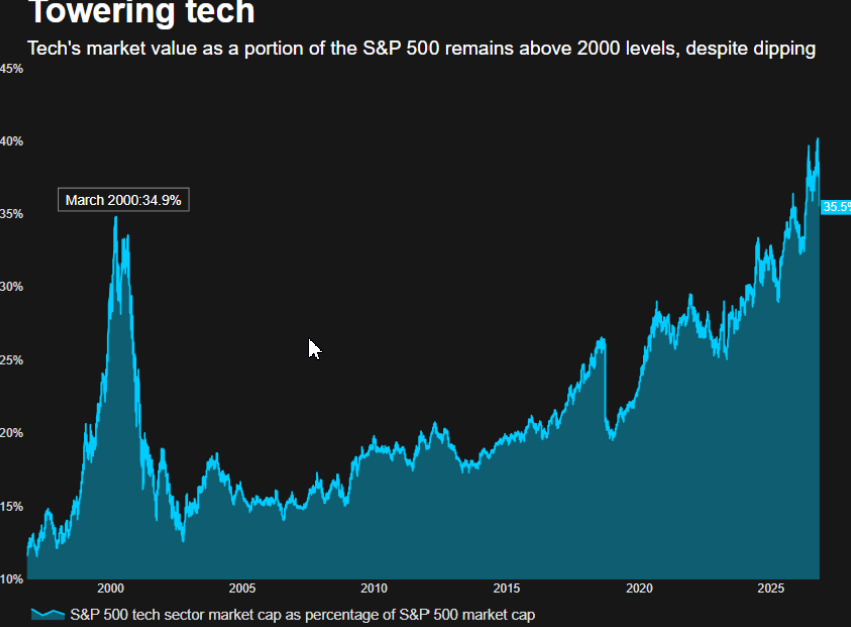
Even with a decline, the technology sector (.SPLRCT) remains the largest component of the S&P 500—the benchmark index for the U.S. stock market. As of Thursday’s close, the tech sector still held a weighting of over 35% within the S&P 500 (.SPX), despite a slight decrease in its influence.
“Because so much of the technology sector is highly sensitive to artificial intelligence, any weakness in AI will impact the entire sector—which, in turn, plays a pivotal role in the S&P 500,” said Robert Pavlik, a senior portfolio manager at Dakota Wealth Management. “Consequently, weakness related to AI would drag down the tech sector, and by extension, the S&P 500.”
The sector’s share of the S&P 500’s total market capitalization remains higher than it was at the peak of the dot-com bubble in 2000.
Within the technology sector specifically, the impact of artificial intelligence extends even further. For instance, three major hyperscale data center operators—Alphabet (GOOGL.O), Amazon (AMZN.O), and Meta Platforms (META.O)—are investing heavily in data center infrastructure, yet they are classified under different sectors.
The continued high weighting of the technology sector is a byproduct of its substantial gains during the U.S. stock market bull run that began in October 2022. Even with a recent pullback, the sector has surged more than 200% over this period—nearly double the gain of the S&P 500 index.
Despite recent declines in their share prices, some of the biggest winners in the artificial intelligence sector have still posted significant gains year-to-date. For instance, shares of Dell Technologies (DELL.N) have risen by approximately 250%, while Micron Technology (MU.O) has climbed by about 160%.
The stock market saw a modest rebound on Friday, with the S&P 500 index up nearly 8% year-to-date—a gain driven in part by the technology sector, which has risen by approximately 11%.
“Even with some investors taking profits, there are still gains to be made,” says Chuck Carlson, CEO of Horizon Investment Services.
The decline in tech stocks has also made their valuations—at least on the surface—appear more reasonable. According to LSEG Datastream, the forward price-to-earnings (P/E) ratio for the technology sector—based on earnings forecasts for the next 12 months—had fallen to 17.1x as of Thursday, down from a peak of over 32x.
The S&P 500 index currently trades at a P/E ratio of 17.9. This week marks the first time since 2017 that the technology sector’s P/E ratio has fallen below that of the broader market.
Keith Lerner, Chief Investment Officer at Truist Advisory Services, noted that the drop in valuations suggests that “arguably… the market has already priced in a lot of bad news.”
“We are reaching a point where even a little bit of good news could have a significant impact,” Lerner said in a statement on Thursday.
In the coming weeks, investors will be closely monitoring several potential catalysts that could influence the trajectory of AI-related trades:
Anthropic IPO: Progress toward an initial public offering (IPO) for the AI lab Anthropic will shape market sentiment regarding AI-related investments. Reuters reported on Thursday that potential investors have expressed skepticism about whether the company can proceed with its planned IPO roadshow next week and go public in November—a situation partly reflecting the broader sell-off in tech stocks.
Tech Earnings: While most third-quarter earnings have already been released, some key reports remain on the horizon. Cloud computing firm CoreWeave (CRWV.O) released a report on Tuesday highlighting that Nvidia (NVDA.O)—a leader in the AI space—has been central to financing the infrastructure built for artificial intelligence. Other notable upcoming dates include November 17 for [Nvidia’s] earnings and November 24 for Dell.
Macroeconomic Backdrop: Developments in the Middle East are expected to have a broad impact on the stock market. Market expectations that a shift in power in Washington could help bring an end to the conflict contributed to a decline in oil prices this week, which in turn provided a boost to the stock market. However, with the midterm elections concluded, investors remain wary of the potential for escalating tensions. Investors are also closely monitoring the trajectory of interest rates, as well as the extent to which the Federal Reserve will aggressively raise rates in the coming months to curb inflation. Next week’s Consumer Price Index (CPI) report will provide a test of this.